Certified Humanitarian Medical Supply Chain Course
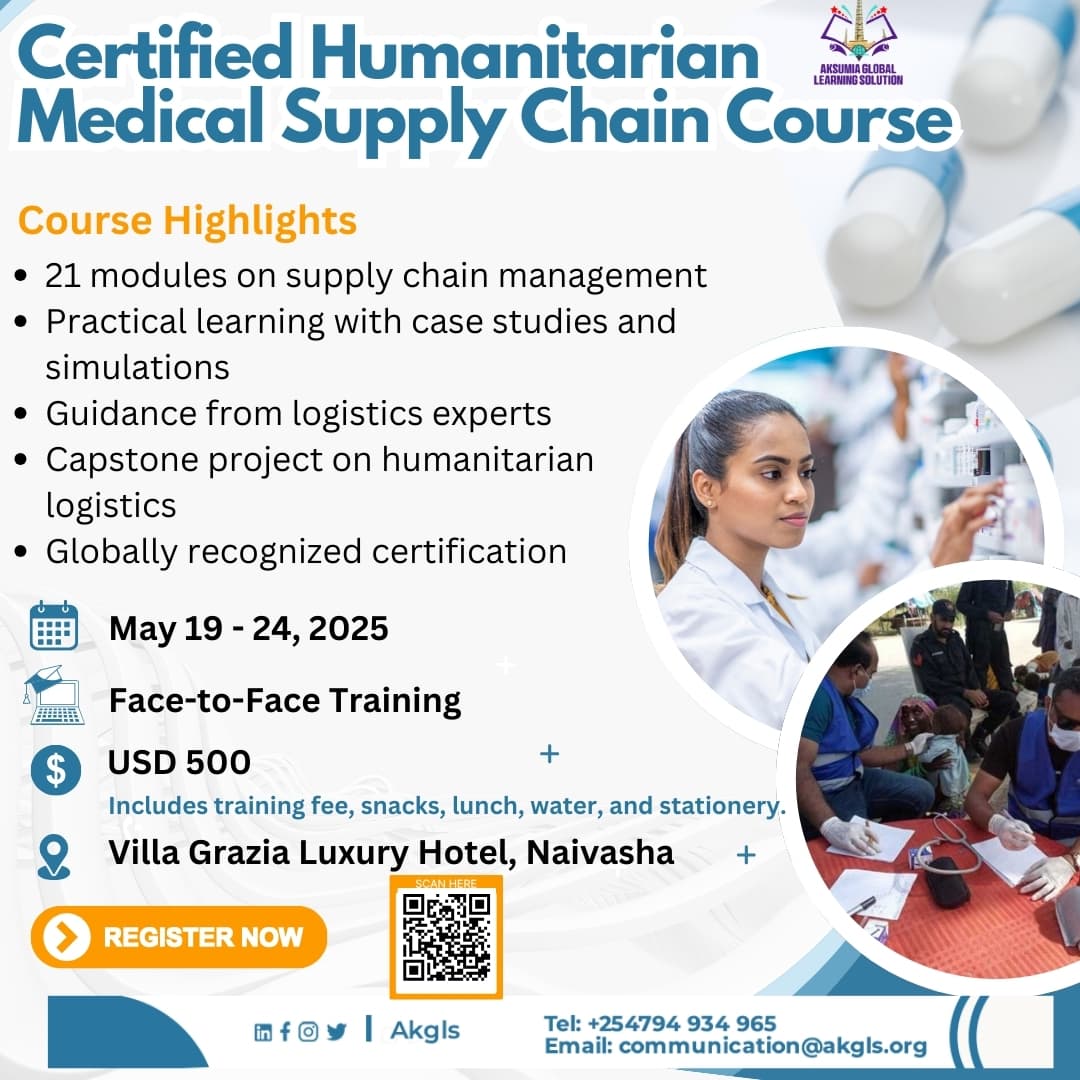
The Certified Humanitarian Medical Supply Chain Course is an intensive 6-day training designed to equip healthcare professionals, supply chain managers, and humanitarian aid workers with the essential skills to manage medical logistics in humanitarian and emergency response settings. This program focuses on technical expertise, strategic decision-making, and ethical considerations, ensuring that participants gain hands-on experience through case studies, practical exercises, and field simulations.
ICT Requirements
By the end of the training, participants will be able to:
Throughout the Certified Humanitarian Medical Supply Chain Course, various assessment techniques will be employed to evaluate participants' understanding and proficiency:
Pre-Test: Evaluates baseline knowledge before training.
Continuous Assessment: Includes online quizzes, short exercises, and active participation in sessions.
Project Evaluation: Assessed based on presentation depth, creativity, and feasibility.
Case Studies: Practical application of real-world humanitarian logistics scenarios.
Self-Paced Learning: Additional practice through LMS-based tests.
Post-Test: Comprehensive final evaluation to measure learning outcomes.
To qualify for a certificate of competence, candidates must achieve a minimum passing score of 80% on the post-test administered at the end of the training.
This course is designed for healthcare professionals and other individuals interested in regulatory affairs.
To obtain CPD or CME Credit, complete the post-tests with an 80% pass rate. Complete the evaluation survey online and submit. A certificate will be mailed within a week of course completion date to the email address provided at the time of registration.
This module provides a foundational understanding of humanitarian medical logistics and supply chain management.
By the end of this module, participants will be able to:
1. Define the core principles of humanitarian medical supply chain management and its role in global health responses.
2. Differentiate between commercial and humanitarian medical supply chains, understanding their key operational distinctions.
3. Analyze the challenges of logistics coordination during global health emergencies, disasters, and pandemics.
4. Evaluate the legal and ethical considerations in humanitarian logistics, ensuring compliance with international regulations.
5. Identify key stakeholders (e.g., WHO, UN agencies, NGOs, donors) and their roles in humanitarian medical supply chain operations.
This module explores the critical role of emergency preparedness and disaster logistics in humanitarian medical supply chain management. Participants will learn how to design and implement rapid response supply chains during crises, develop contingency plans to mitigate risks, and apply pre-positioning and stockpiling strategies for essential medical supplies.
By the end of this module, participants will be able to:
1. Explain the principles of rapid response supply chain setup in humanitarian crises.
2. Develop effective contingency planning and risk mitigation strategies for disaster scenarios.
3. Implement best practices for pre-positioning and stockpiling essential medical supplies in emergency settings.
4. Analyze real-world case studies of medical supply chain responses during pandemics and natural disasters.
5. Evaluate the challenges and solutions in disaster logistics management for improved emergency response.
This module provides an in-depth understanding of Logistics Management Information Systems (LMIS) and their role in humanitarian medical supply chain management. Participants will explore how LMIS supports data collection, reporting, and decision-making in humanitarian settings, ensuring the efficient flow of medical supplies.
By the end of this module, participants will be able to:
1. Describe the role of LMIS in improving humanitarian medical supply chain efficiency.
2. Apply key data collection, reporting, and decision-making tools used in humanitarian logistics.
3. Analyze the challenges and solutions in integrating LMIS with national health systems.
4. Evaluate the impact of successful LMIS implementation in real-world humanitarian settings.
5. Utilize LMIS principles to improve visibility, forecasting, and supply chain coordination in emergency responses.
This module focuses on the principles and best practices for managing inventory and stock levels in humanitarian medical supply chains. Participants will learn how to conduct physical inventory assessments, adjust consumption data for accuracy, and apply Max-Min inventory control strategies to ensure a continuous and efficient supply of essential medical products.
By the end of this module, participants will be able to:
1. Conduct effective physical inventory assessments to ensure stock accuracy and availability.
2. Apply appropriate consumption data adjustments to maintain accurate stock levels in humanitarian operations.
3. Implement Max-Min inventory control principles to optimize stock management in disaster response settings.
4. Develop demand forecasting models to prevent stockouts and overstocking of essential medicines and supplies.
5. Plan and manage emergency buffer stocks to enhance supply chain resilience during crises.
This module provides participants with essential skills in drug selection, quantification, and supply planning for humanitarian medical supply chains. Participants will learn about evidence-based drug selection criteria, including WHO model lists, VEN (Vital, Essential, Non-Essential), and ABC (Activity-Based Classification) analysis.
By the end of this module, participants will be able to:
1. Apply appropriate drug selection criteria based on WHO model lists, VEN analysis, and ABC classification to ensure rational selection of health commodities.
2. Demonstrate proficiency in quantification and forecasting methodologies to determine the required quantities of medical supplies in humanitarian operations.
3. Develop supply planning strategies to mitigate stockouts and overstocking in emergency settings.
4. Adapt quantification processes in dynamic humanitarian environments to respond to changing health needs and emergencies.
5. Evaluate case studies on successful product selection and quantification in global humanitarian health programs.
This module provides an in-depth understanding of the in-kind supply chain in humanitarian settings, focusing on the management, planning, and integration of donated medical supplies into existing logistics systems.
By the end of this module, participants will be able to:
1. Define the role and significance of in-kind supply chain management in humanitarian healthcare delivery.
2. Analyze the challenges and risks associated with donated medical supplies, including quality, storage, and regulatory concerns.
3. Develop effective needs assessment and planning strategies to align donations with actual healthcare demands.
4. Implement supply chain integration strategies to incorporate donated medical supplies into existing logistics frameworks.
5. Evaluate regulatory and quality assurance measures to ensure the safety, efficacy, and compliance of donated medical products.
This module provides a comprehensive overview of procurement processes and supplier management in humanitarian medical supply chains. Participants will gain insights into best practices for procurement, international regulatory frameworks such as WHO Good Procurement Practices and INCO Terms, and strategies for supplier selection, contract management, and performance monitoring.
By the end of this module, participants will be able to:
1. Explain the key procurement processes and best practices in humanitarian medical supply chain management.
2. Apply international procurement regulations, including WHO Good Procurement Practices and INCO Terms, to ensure compliance and efficiency.
3. Develop effective strategies for supplier selection, contract management, and performance evaluation in humanitarian logistics.
4. Implement risk management frameworks to prevent fraud and corruption in procurement processes.
5. Formulate strategies for sourcing essential medical supplies during humanitarian crises and emergency response situations.
This module provides participants with a comprehensive understanding of warehousing, inventory management, and stock control in humanitarian medical supply chains. It focuses on warehouse setup and operations in emergency settings, essential stock control techniques such as FIFO (First-In, First-Out), FEFO (First-Expired, First-Out), and Just-in-Time inventory management, and the critical role of cold chain management for vaccines and biologics.
By the end of this module, participants will be able to:
1. Design efficient warehouse operations and layout plans for humanitarian settings.
2. Apply appropriate stock control techniques such as FEFO, FIFO, and Just-in-Time to minimize waste and optimize inventory.
3. Implement cold chain management best practices for handling temperature-sensitive vaccines and biologics.
4. Develop emergency stockpiling strategies to enhance disaster preparedness and response.
5. Plan and optimize last-mile distribution to ensure timely delivery of medical supplies in remote or crisis-affected areas.
This module provides participants with critical knowledge and practical strategies for managing transportation, distribution, and cold chain logistics in humanitarian medical supply chains. It explores the various modes of transport (air, sea, road, multimodal logistics) used in humanitarian settings, as well as challenges in last-mile delivery to crisis-affected regions.
By the end of this module, participants will be able to:
1. Evaluate different modes of transport and their suitability for humanitarian medical logistics.
2. Identify key challenges in last-mile delivery and propose solutions for efficient humanitarian aid distribution.
3. Implement cold chain logistics and temperature monitoring strategies to maintain the integrity of vaccines and biologics.
4. Assess the role of third-party logistics (3PL) partnerships in enhancing humanitarian transport operations.
5. Develop security, risk management, and contingency plans for medical supply transportation in high-risk environments.
This module provides an in-depth understanding of fleet management in humanitarian logistics, focusing on vehicle selection, operation, and maintenance in crisis environments. Participants will explore strategies for fuel efficiency, route optimization, and environmental sustainability while ensuring the safety and compliance of drivers with humanitarian logistics policies.
By the end of this module, participants will be able to:
1. Evaluate the criteria for fleet selection, operation, and maintenance in remote and crisis-affected areas.
2. Implement strategies for fuel efficiency, route optimization, and environmentally sustainable fleet management in humanitarian logistics.
3. Develop training programs to ensure driver safety, compliance, and adherence to humanitarian logistics policies.
4. Coordinate emergency fleet operations, including vehicle tracking and rapid deployment in humanitarian responses.
5. Assess challenges and propose solutions for fleet management in humanitarian operations based on real-world case studies.
This module explores the role of Cash and Voucher Assistance (CVA) in humanitarian logistics, focusing on how cash transfer programming enhances flexibility, efficiency, and empowerment in emergency response.
By the end of this module, participants will be able to:
1. Explain the fundamentals of cash transfer programming (CTP) and its role in humanitarian logistics.
2. Conduct market assessments and feasibility analyses to determine the suitability of CVA interventions.
3. Integrate procurement and supply chain strategies to support effective CVA implementation.
4. Monitor and evaluate CVA programs, ensuring efficiency, transparency, and impact.
This module explores the impact of digitalization and emerging technologies in humanitarian medical supply chains, emphasizing how digital tools enhance tracking, monitoring, transparency, and coordination in logistics operations.
By the end of this module, participants will be able to:
1. Describe the role of digital tools in enhancing visibility and efficiency in humanitarian medical supply chains.
2. Apply blockchain technology to improve transparency, reduce fraud, and enhance traceability in medical logistics.
3. Utilize AI and predictive analytics to improve demand forecasting and optimize inventory management in humanitarian settings.
4. Leverage real-time data-sharing platforms to improve coordination among humanitarian actors.
This module provides essential knowledge and best practices in medical waste management and disposal in humanitarian settings.
By the end of this module, participants will be able to:
1. Explain the importance of safe disposal of pharmaceuticals and medical equipment in humanitarian settings.
2. Classify different types of medical waste and apply appropriate segregation methods for effective waste management.
3. Implement WHO guidelines on medical waste management in humanitarian health facilities.
4. Evaluate environmental considerations and best practices for sustainable healthcare waste disposal.
This module focuses on coordination and response mechanisms in humanitarian medical supply chains, emphasizing collaboration among key humanitarian actors.
By the end of this module, participants will be able to:
1. Analyze the roles and responsibilities of key humanitarian actors in coordinating medical supply chains.
2. Implement emergency response logistics and disaster preparedness strategies for efficient supply chain operations.
3. Apply performance measurement tools to monitor and optimize humanitarian supply chain efficiency.
4. Evaluate challenges and solutions in supply chain coordination in humanitarian crises.
This module provides an understanding of regulatory and quality assurance frameworks governing humanitarian medical supply chains.
By the end of this module, participants will be able to:
1. Explain the WHO prequalification process for medicines, vaccines, and diagnostics.
2. Apply national and international regulatory frameworks in humanitarian medical supply chain operations.
3. Implement Good Distribution Practices (GDP) to ensure compliance and quality in humanitarian logistics.
4. Evaluate pharmaceutical quality assurance mechanisms in humanitarian settings to maintain product integrity and safety.
This module explores the policy and governance structures that shape public health and pharmaceutical supply chains in humanitarian settings.
By the end of this module, participants will be able to:
1. Analyze the policy and governance frameworks that regulate public health and humanitarian pharmaceutical supply chains.
2. Demonstrate strategies for integrating public health programs with humanitarian logistics to improve medical supply access.
3. Evaluate the impact of public-private partnerships (PPPs) in global health logistics and their role in strengthening supply chains.
4. Apply ethical decision-making principles in pharmaceutical supply chain governance, ensuring equitable and transparent distribution.
This module explores the principles of sustainability and green logistics in humanitarian medical supply chains, focusing on reducing the environmental impact of humanitarian operations.
By the end of this module, participants will be able to:
1. Assess the environmental impact of humanitarian logistics and develop sustainable strategies to mitigate negative effects.
2. Implement eco-friendly packaging, transport, and waste reduction practices in humanitarian supply chain operations.
3. Evaluate the use of renewable energy solutions to enhance supply chain sustainability in crisis settings.
4. Develop strategies to reduce the carbon footprint in health supply chain management.
This module provides a comprehensive understanding of financial planning, budgeting, and cost management in humanitarian health supply chains.
By the end of this module, participants will be able to:
1. Develop effective financial planning and budgeting strategies for humanitarian medical supply chain operations.
2. Apply cost optimization techniques to improve efficiency and reduce wastage in health supply chains.
3. Conduct a cost-benefit analysis of humanitarian logistics interventions to support decision-making.
4. Manage donor funding and financial accountability to ensure transparency and compliance in health supply chains.
This module focuses on the critical role of leadership and human resource management in humanitarian medical supply chains.
By the end of this module, participants will be able to:
1. Demonstrate effective leadership skills tailored for humanitarian logistics and emergency response.
2. Manage multicultural teams efficiently in diverse and high-stress humanitarian supply chain environments.
3. Develop strategies for staff recruitment, training, and retention to enhance workforce stability in humanitarian logistics.
4. Implement resilience and stress management techniques to improve the well-being of humanitarian health workers.
This module explores the ethical principles, equity considerations, and human rights issues that shape humanitarian medical supply chains.
By the end of this module, participants will be able to:
1. Explain the role of humanitarian logistics in ensuring equitable healthcare access for vulnerable populations.
2. Identify ethical dilemmas in humanitarian medical logistics and develop strategies to address them.
3. Analyze the impact of gender and inclusion issues on supply chain operations in humanitarian settings.
4. Apply ethical frameworks and human rights principles in humanitarian supply chain decision-making.
This hands-on, experiential module immerses participants in realistic humanitarian crisis simulations, allowing them to apply their knowledge, decision-making skills, and problem-solving abilities in a controlled, high-pressure environment.
By the end of this module, participants will be able to:
1. Apply humanitarian logistics principles in simulated crisis response scenarios.
2. Demonstrate problem-solving skills in medical supply chain emergencies through role-playing and field exercises.
3. Develop and present a comprehensive response plan for a humanitarian logistics operation.
4. Enhance teamwork, leadership, and decision-making skills in high-pressure situations.
Start straight away and join a global classroom of learners. If the course hasn't started yet, you'll see the future date listed below.
Join Today Available now